
Recurring expenses are easy to underestimate because they are scattered across payment cards, app stores, email receipts, and annual contracts. The small monthly charges get familiar; the annual ones disappear until renewal day. One complete list turns both kinds into decisions you can make ahead of time.
What counts as a recurring expense?
Include any cost you reasonably expect to repeat, even if the amount or exact date changes:
- fixed monthly bills: rent, memberships, software, phone plans;
- variable bills: electricity, water, usage-based services;
- less frequent renewals: insurance, annual subscriptions, licenses, domain names;
- scheduled income: salary, benefits, or predictable client retainers;
- installments: loans or payment plans with a known end date.
Tracking recurring income alongside expenses helps you see cash timing. But keep the two totals separate: expected income does not cancel the operational risk of a bill arriving before payday.
Step 1: Search the places where charges hide
Review at least twelve months if you want to catch annual renewals. Search checking and card statements for repeat merchants, then check:
- Apple, Google, Microsoft, gaming, or other app-store subscription pages;
- email for “renewal,” “subscription,” “membership,” “invoice,” and “receipt”;
- PayPal or other wallet automatic-payment settings;
- insurance policies and professional memberships;
- shared household services paid by someone else but reimbursed by you.
Do not stop when you find familiar entertainment subscriptions. Insurance, cloud storage, security software, delivery memberships, bank fees, donations, and domain renewals are often more consequential.
Step 2: Record enough information to act
A merchant and amount are not enough. Your recurring-expense tracker should contain:
| Field | Why it matters |
|---|---|
| Name and category | Lets you group costs and recognize unfamiliar statement text |
| Amount and frequency | Shows the real periodic and annual cost |
| Next charge date | Supports cash planning |
| Cancellation deadline | Tells you the last useful decision date |
| Payment account | Prevents failed payments and helps when replacing a card |
| Owner and login route | Clarifies who can manage a shared household service |
| Notes | Captures contract term, price changes, or an expected end date |
Step 3: Normalize monthly and annual costs
Different billing cycles are hard to compare. Calculate an annualized total and a monthly equivalent:
- monthly charge × 12 = annual cost;
- quarterly charge × 4 = annual cost;
- weekly charge × 52 = approximate annual cost;
- annual charge ÷ 12 = monthly equivalent.
A $9 weekly service is roughly $468 per year, not $432. A $120 annual subscription is a $10 monthly commitment even though no charge appears in most months. Normalized values help compare services; the actual charge dates still matter for cash flow.
Step 4: Handle variable bills with a range
For utilities and other variable recurring costs, record the typical amount and a safe high estimate. Use the average of recent comparable months, but account for seasonality: last winter may predict heating better than last summer.
The high estimate is a planning guardrail, not a prediction. If the actual bill is lower, the unused amount can remain as a utility buffer or return to the broader plan.
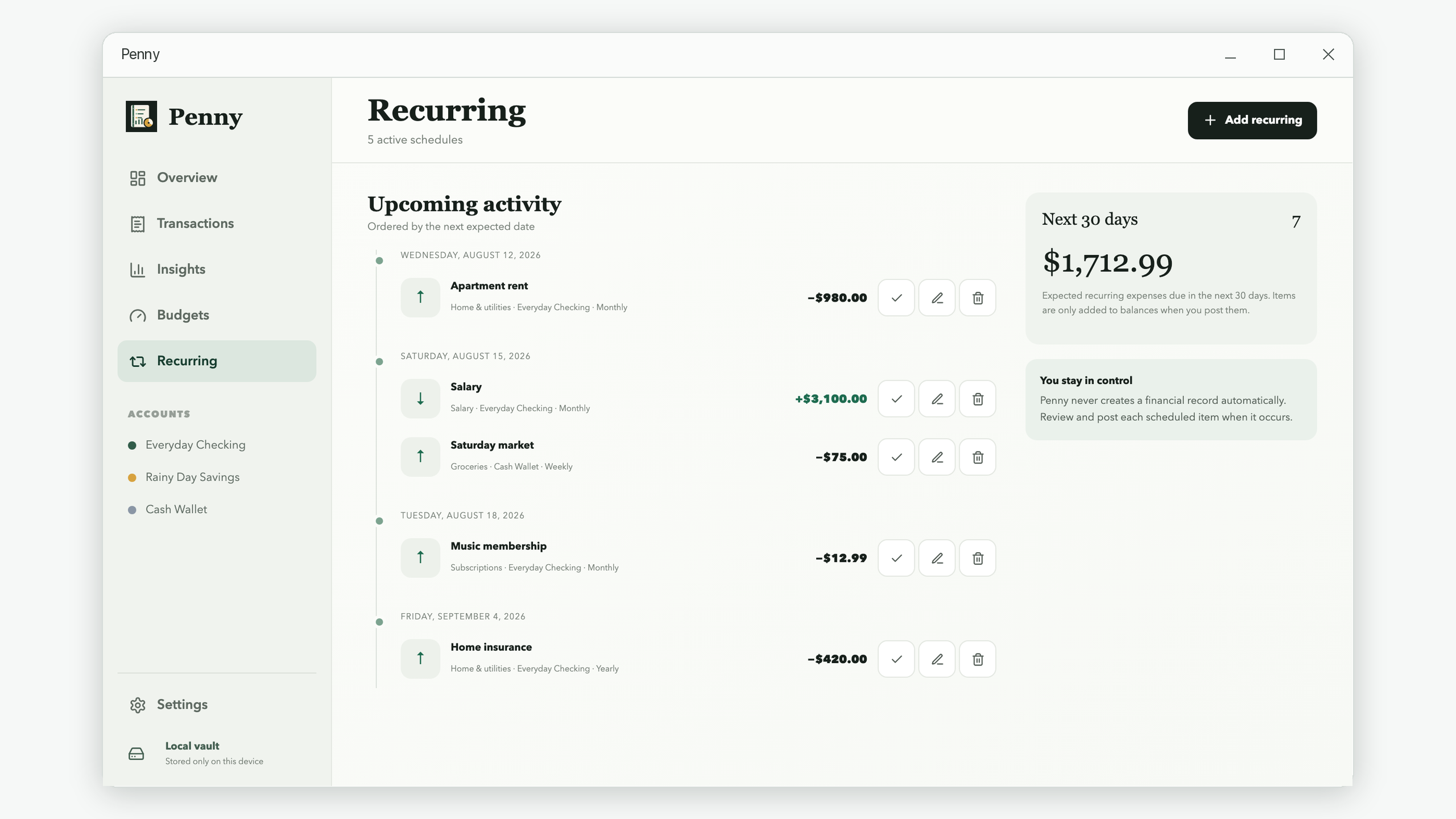
Step 5: Build a forward renewal calendar
Put upcoming charges in date order and look at the next 30, 60, and 90 days. Add a review reminder before the cancellation or negotiation deadline. Useful lead times include:
- 7–14 days for simple month-to-month subscriptions;
- 30 days for annual software and memberships;
- 45–60 days for insurance, phone, internet, or contracts you may compare;
- earlier when cancellation requires notice by mail or another slow process.
A plain calendar works. A spreadsheet can sort by date. A personal-finance app can place schedules beside the accounts they affect. Whichever tool you choose, keep one authoritative list rather than several partial reminders.
Step 6: Review value, not just price
For each optional renewal, choose one of five actions: keep, cancel, downgrade, pause, or negotiate. Ask:
- Did I use this during the last billing period?
- Would I buy it again today at the renewal price?
- Does another service already provide the same result?
- Could a lower tier or annual plan reduce cost without creating lock-in risk?
- Is there data I need to export before cancellation?
Do not cancel essential protection solely because it looks expensive in a normalized list. The review is about value and alternatives, not maximizing the number of cancellations.
Step 7: Verify each occurrence before treating it as complete
A schedule is an expectation, not proof that a transaction occurred. Prices change, dates shift, payments fail, and annual renewals may include tax. Compare the expected item with the real posted transaction, update the next date and amount, and investigate differences.
This small verification prevents a recurring template from silently manufacturing incorrect history. It also catches price increases while you may still be able to request a refund or change the plan.
Copy this recurring-expense template
- Service or bill name
- Expense or income
- Category
- Expected amount or range
- Frequency
- Next charge date
- Cancellation or review date
- Payment account
- Contract end date, if any
- Decision: keep, cancel, downgrade, pause, negotiate
Review the list monthly for near-term items and do a deeper audit every three to six months. Also review immediately after replacing a payment card, changing banks, moving home, or changing household responsibilities.
Frequently asked questions
What counts as a recurring expense?
Any expected repeating cost, including fixed bills, variable utilities, subscriptions, insurance, annual fees, and installments.
How far ahead should I review a renewal?
Work backward from the cancellation deadline. Fourteen to thirty days is enough for many subscriptions; insurance and contracts often need more lead time.
How do I budget for an annual subscription?
Reserve one-twelfth each month if the renewal is a year away. If it is sooner, divide the amount by the months remaining.