You check the budget and see $420 left for the month. Your checking account shows $1,780. Neither number is necessarily wrong. They answer different questions, and treating them as interchangeable can lead to overspending or unnecessary anxiety.
The short answer: a balance is a stock; a budget is a flow
Your bank balance answers: “How much money is in this account right now?” It includes money carried from earlier months and may be affected by pending activity.
Your budget answers: “How much of this period's income have I assigned, spent, or reserved?” It usually spans several accounts and ignores money that already had a purpose before the current month.
Reason 1: transactions belong to different dates
A purchase date, statement date, posting date, and payment date can all differ. Your budget may count a purchase when you made it while the bank does not reduce the available balance until the merchant finishes processing it. A rent payment scheduled for tomorrow may be reserved in the budget even though it is still visible in checking today.
Choose one consistent rule for tracking—usually the transaction or posting date—and use it throughout the month. The exact convention matters less than avoiding a mixture.
Reason 2: transfers move money but do not create spending
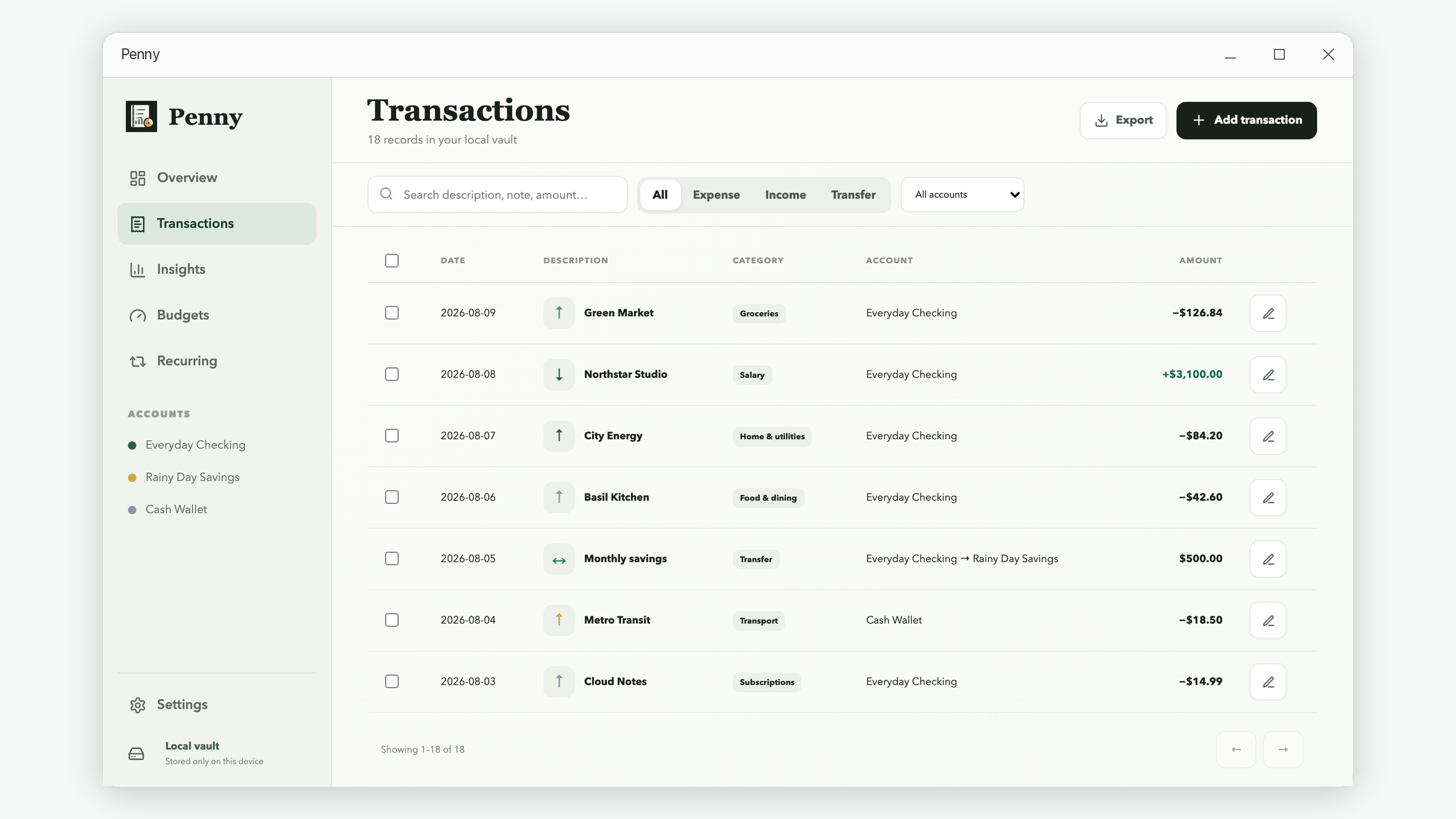
Moving $500 from checking to savings lowers one balance and raises another. Your total money has not changed, and the transfer is not an expense unless you deliberately define the destination as money no longer available to the plan.
Transfers are a common source of double counting. If you label the checking withdrawal as an expense and also treat the savings deposit as saved money, the same movement appears twice. Record the two sides as a transfer between accounts.
Reason 3: credit-card purchases and payments happen at different times
Suppose you buy $80 of groceries with a credit card. The budget should usually record $80 of grocery spending on the purchase date. When you later pay the card from checking, that movement is a transfer that settles the liability—not another $80 expense.
If you track only checking, the payment creates a large drop long after the individual purchases occurred. If you track the card too, its negative balance shows what you owe and category spending stays attached to the original purchases.
| Event | Budget effect | Account effect |
|---|---|---|
| $80 grocery purchase on card | $80 grocery expense | Card liability increases by $80 |
| $80 card payment from checking | No new expense | Checking falls; card liability falls |
| $500 checking-to-savings transfer | No expense by default | Checking falls; savings rises |
Reason 4: pending, duplicated, or reversed activity
Restaurants, fuel stations, hotels, and online merchants may place temporary authorizations that later change. An imported or manually entered pending charge can appear alongside the posted version. Refunds can arrive in a later month. These are account-state issues, not proof that the budget formula is broken.
Do not permanently adjust a category to force agreement with a pending balance. Verify the merchant, amount, and status. Replace the temporary record when the final transaction posts.
Reason 5: cash, reimbursements, and refunds need explicit treatment
An ATM withdrawal moves money from checking into cash. The expense happens when the cash is spent, unless you intentionally use a simplified method that categorizes the whole withdrawal. Mixing these approaches makes both balances and categories unreliable.
Reimbursements need a consistent rule too. You can reduce the original expense category when the reimbursement arrives or treat it as reimbursement income. The first approach better shows your net cost; the second preserves gross spending. Choose the view that supports your decision and apply it consistently.
Reason 6: the opening balance may be missing or wrong
A transaction list can be perfectly categorized and still produce the wrong current balance if the starting amount was inaccurate. When you begin tracking an existing account, record its balance at a known point. From then on:
opening balance + income − expenses ± transfers = calculated current balance.
If that calculated amount differs from the institution's posted amount, reconciliation finds the missing or incorrect activity.
How to reconcile without forcing the numbers
- Pick a statement or posted balance. Note the account and exact date.
- Confirm the opening balance. Start from a previously reconciled point if possible.
- Compare transactions in order. Match date, amount, and direction.
- Mark transfers as transfers. Confirm both accounts contain the corresponding side.
- Check card payments. Make sure purchases are expenses and payments are not duplicates.
- Separate pending activity. Reconcile to posted transactions, then account for genuine pending items separately.
- Correct the record, not the category target. A balancing adjustment should be a last resort with a clear note.
- Difference equals a familiar bill? Look for a missing transaction.
- Difference is exactly doubled? Look for a duplicate or transfer recorded as expense.
- Difference equals a card payment? Check whether purchase and payment were both categorized.
- Small changing difference? Check pending tips, fuel holds, or exchange adjustments.
- Difference existed from day one? Recheck the opening balance.
Which number should guide a spending decision?
Use both, but for different safety checks. The bank balance tells you whether the account can cover near-term payments. The budget tells you whether that money is already assigned to rent, a future renewal, savings, or another category.
A large account balance is not automatically spendable. A positive category balance is not permission to ignore cash timing. A sound decision needs enough money in the correct account and enough unspent room in the plan.
Frequently asked questions
Should my budget equal my bank balance?
No. A budget covers activity and assignments during a period; a bank balance shows one account at one moment.
Does a credit-card payment count as an expense?
Not if the underlying purchases were already recorded as expenses. The payment is then a transfer that reduces checking and the card liability.
How often should accounts be reconciled?
A short weekly check catches most errors while they are recognizable. Finish with a reconciliation during your monthly review.