
If your budget fails by the second week, the problem may not be discipline. The numbers may have been invented before you looked at your real spending. A realistic monthly budget begins with evidence, accounts for costs that do not arrive every month, and includes room for ordinary surprises.
What “realistic” means in a monthly budget
A budget is realistic when you can follow it during a normal month—not just an unusually quiet one. It should cover essential commitments, reflect your actual habits, and still move money toward savings or debt goals.
It also needs a way to adapt. Prices change. A school expense appears. A category estimate turns out to be wrong. A budget that cannot be revised becomes a scorecard; a budget that can be revised remains a decision tool.
Step 1: Gather one to three months of real numbers
Start with recent bank and credit-card statements. One month is enough to begin; three months gives you a better view of categories that vary. Record:
- take-home income that is actually available to spend;
- fixed bills such as housing, insurance, internet, and minimum debt payments;
- variable essentials such as groceries, transportation, and utilities;
- flexible spending such as dining, hobbies, and shopping;
- non-monthly expenses such as annual fees, gifts, repairs, and travel.
Do not “correct” the history while collecting it. If you spent more on dining than you wanted, keep the real number. You need an honest baseline before you can choose a better target.
Step 2: Use dependable take-home income
Budget with money you reasonably expect to receive after taxes and deductions. If your income varies, use a conservative baseline: for example, the lowest ordinary month from the last six months, or an average with a safety reduction. Treat income above that baseline as extra only after it arrives.
This avoids committing uncertain money to fixed obligations. You can later define an order for extra income—perhaps replenishing the buffer first, then debt, savings, and optional spending.
Step 3: Protect fixed commitments first
List costs that are difficult to change during the month. Housing, utilities, insurance, childcare, debt minimums, and essential transport usually belong here. Use due dates as well as amounts: a plan can work on paper and still cause stress if most bills land before the next payday.
If fixed commitments consume too much of dependable income, squeezing grocery estimates will not solve the structural problem. The useful questions become larger: can a contract be renegotiated, a debt refinanced, a subscription removed, or income increased?
Step 4: Set variable categories from a baseline
For each variable category, calculate a recent average and then decide whether to maintain or change it. A target should be specific enough to guide a decision, but not so granular that tracking becomes the main activity.
| Category | Recent average | New target | Reason |
|---|---|---|---|
| Groceries | $520 | $500 | Small reduction with meal planning |
| Dining out | $240 | $160 | Keep one planned meal each week |
| Transport | $180 | $200 | Allow for fuel-price variation |
| Personal | $95 | $100 | Round to an easy working limit |
A dramatic cut can look productive and still be useless. Reducing a category by 10–20% is often easier to test than pretending it can disappear. The right number is the one that supports your priorities and survives contact with the month.
Step 5: Convert irregular costs into monthly amounts
Many “unexpected” expenses are predictable but infrequent. An annual insurance premium, holiday travel, vehicle service, or professional renewal should not surprise a monthly plan.
Add expected costs for the next year, divide each by the number of months remaining, and reserve that amount monthly. If a $600 renewal is due in six months, the current plan needs $100 per month—not $50—because there are only six contributions left.
These reserves are often called sinking funds. They are not spending mistakes; they are monthly preparation for known future spending.
Step 6: Add a buffer on purpose
A buffer covers small variations without forcing a complete rewrite. It is separate from an emergency fund, which is for larger disruptions. The amount depends on how stable your costs are, but even a modest line item can absorb a higher utility bill, a forgotten school fee, or price changes.
If the plan does not fit, change it before the month begins. Reduce lower-priority flexible categories, extend a goal timeline, or revisit a fixed cost. Do not hide the gap by assuming next month will somehow be cheaper.
Step 7: Check progress weekly, not constantly
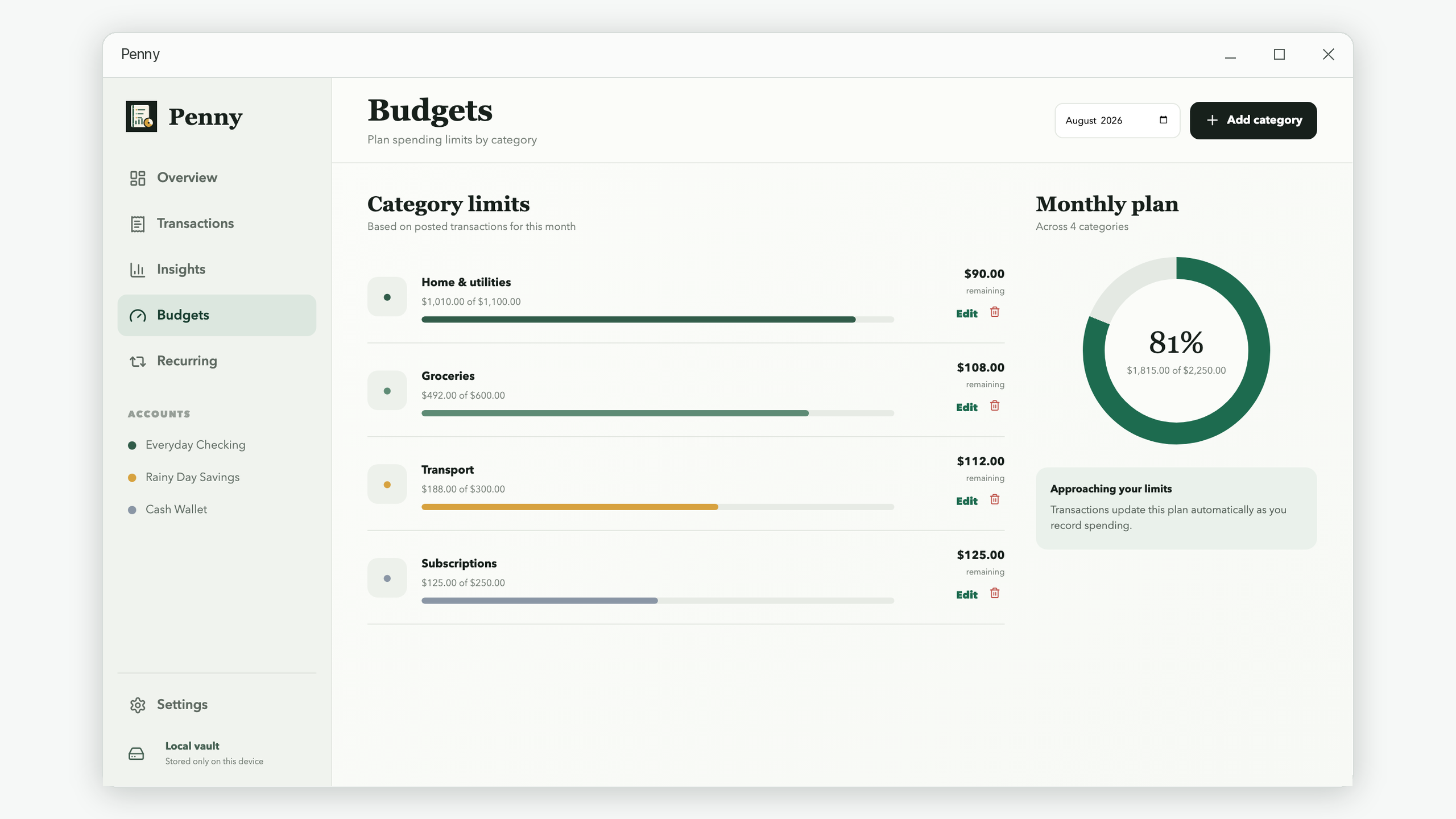
A short weekly check is enough for most people. Review posted activity, correct categories, and look at the few flexible categories that can still change. A grocery limit matters before the next shopping trip; it is only trivia after the month ends.
When a category goes over, choose explicitly:
- move money from a lower-priority category;
- reduce later spending in the same category;
- use part of the buffer; or
- accept that the estimate was wrong and update next month.
This is why category totals must be based on posted transactions rather than memory. A notebook, spreadsheet, or local finance app can all work—the method matters more than the tool.
A simple first-budget template
- Write down dependable take-home income.
- Reserve fixed bills and minimum debt payments.
- Fund savings and known future expenses.
- Set variable targets from recent averages.
- Add a small buffer.
- Confirm the total fits available income.
- Review flexible categories once a week.
- At month-end, change estimates—not history.
Percent rules such as 50/30/20 can be a useful diagnostic, but they are not a universal budget. Housing costs, family responsibilities, debt, and local prices vary. Use a rule to ask questions, not to declare that a workable plan is wrong.
Frequently asked questions
How many budget categories should I use?
Use the smallest set that helps you make decisions. Six to twelve categories is a manageable starting point. Split a category only when the extra detail changes what you will do.
What if I overspend one category?
Reallocate from a lower priority, reduce later spending, or revise the estimate. Overspending is information about the plan; it does not invalidate the entire month.
Should savings be part of the budget?
Yes. Planned savings and extra debt payments are deliberate uses of income. Giving them a line in the plan prevents them from depending on whatever happens to remain.